

A Connecticut Yankee in King Arthur's Court
Mark Twain
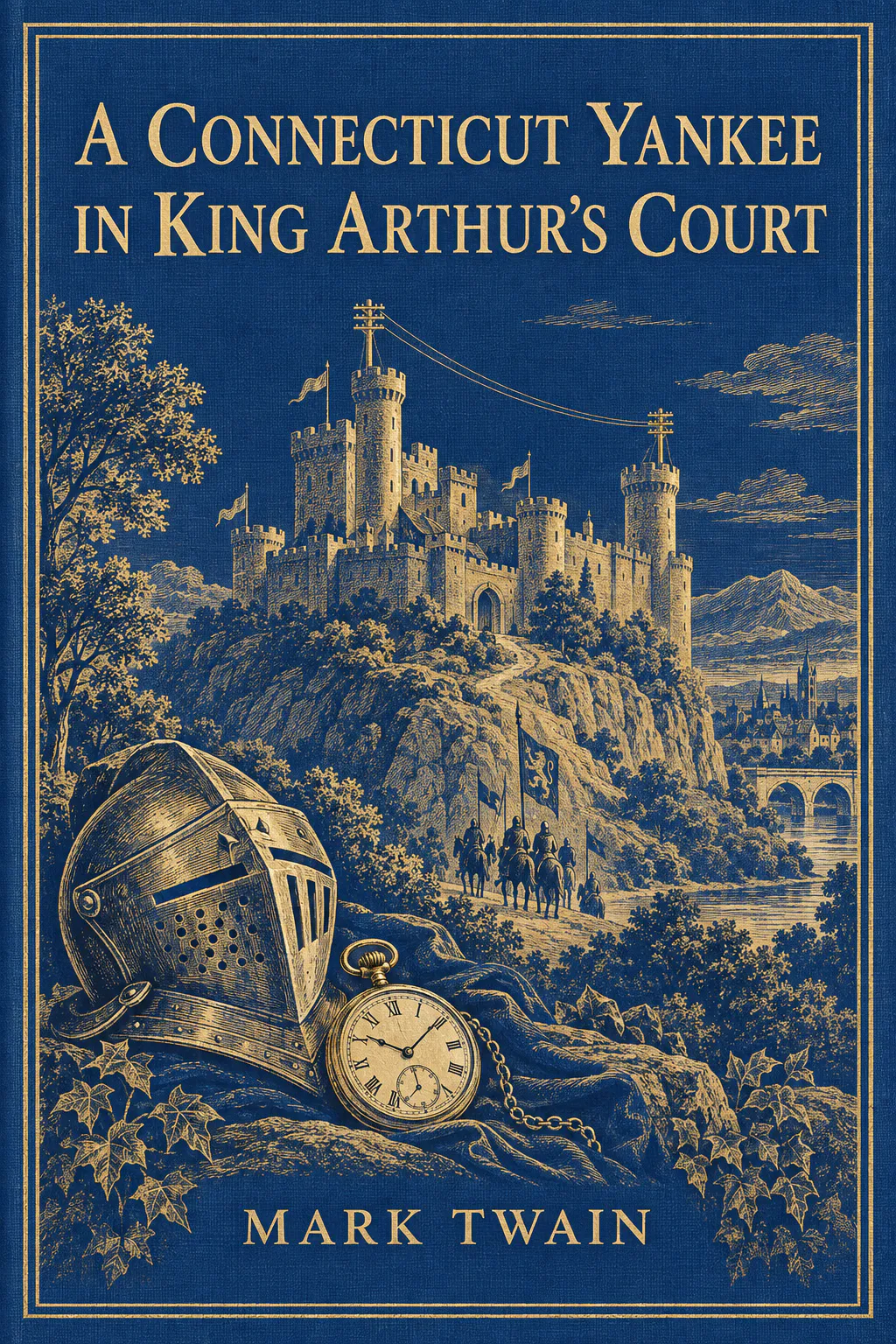
A Connecticut Yankee in King Arthur's Court
FictionClassicsScience FictionFantasyHumor & SatireMyths, Fairy Tales & Folklore
13h 42m listening
3.78from 109,558 ratingson Goodreads
"A Connecticut Yankee in King Arthur's Court" by Mark Twain is a novel published in 1889. When Hank Morgan, a Connecticut engineer, receives a blow to the head, he awakens in medieval England during King Arthur's reign. Using his modern knowledge, he poses as a powerful magician and becomes the king's chief adviser. Hank attempts to modernize the past and implement democratic reforms, but faces opposition from Merlin, the nobility, and the Church in this satirical tale about progress, power, and conflicting eras.
Contains spoilers for the entire book
- Themes
- Atmosphere
About the book
Published in 1889, A Connecticut Yankee in King Arthur’s Court follows Hank Morgan, a head superintendent at an arms factory in Hartford, who is knocked out in a fight and wakes in sixth-century England. Taken for a dangerous oddity at Camelot, he saves himself by predicting an eclipse and soon sets about remaking the kingdom with factories, newspapers, telephones and schools. Mark Twain uses the collision of eras for broad comedy, mocking knight-errantry, inherited rank and the power of the established Church. The satire cuts both ways, though: Hank’s confidence that modern industry can simply be installed in another society is treated with growing unease, and the novel’s humour darkens as his ambitions grow.
Characters
Hank Morgan — Narrator
A Connecticut factory superintendent transported to Arthurian Britain, where his technical knowledge earns him the title of the Boss.
King Arthur — King
The ruler of Camelot, whose chivalric ideals Hank tests against the lives of ordinary people.
Merlin — Court magician
An established authority at Camelot who resents Hank's apparent magical powers.
Clarence — Hank's assistant
A resourceful young page who becomes Hank's trusted helper in modernizing the kingdom.
Alisande (Sandy) — Hank's companion
A noblewoman whose quest draws Hank into the customs and adventures of knight-errantry.
Morgan le Fay — Noblewoman
Arthur's powerful sister, whose hospitality sits uneasily beside her cruelty.
About the author
Mark Twain was the pen name of Samuel Langhorne Clemens (1835–1910), an American writer and humorist born in Florida, Missouri, and raised in Hannibal, a river town on the Mississippi. He worked as a printer and became a licensed Mississippi steamboat pilot before the Civil War ended river traffic, then went west to Nevada and California as a prospector and newspaperman. His story “The Celebrated Jumping Frog of Calaveras County” (1865) and the travel book The Innocents Abroad (1869) made his name. Settled in Hartford, Connecticut, with his wife Olivia Langdon, he wrote The Adventures of Tom Sawyer (1876), The Prince and the Pauper (1881), Life on the Mississippi (1883), Adventures of Huckleberry Finn (1884) and A Connecticut Yankee in King Arthur’s Court (1889). Bad investments bankrupted him in the 1890s, and he paid his debts with a lecture tour around the world. Increasingly bitter after the deaths of his wife and two of his daughters, he died in Connecticut in 1910.