
Adam și Eva
Liviu Rebreanu
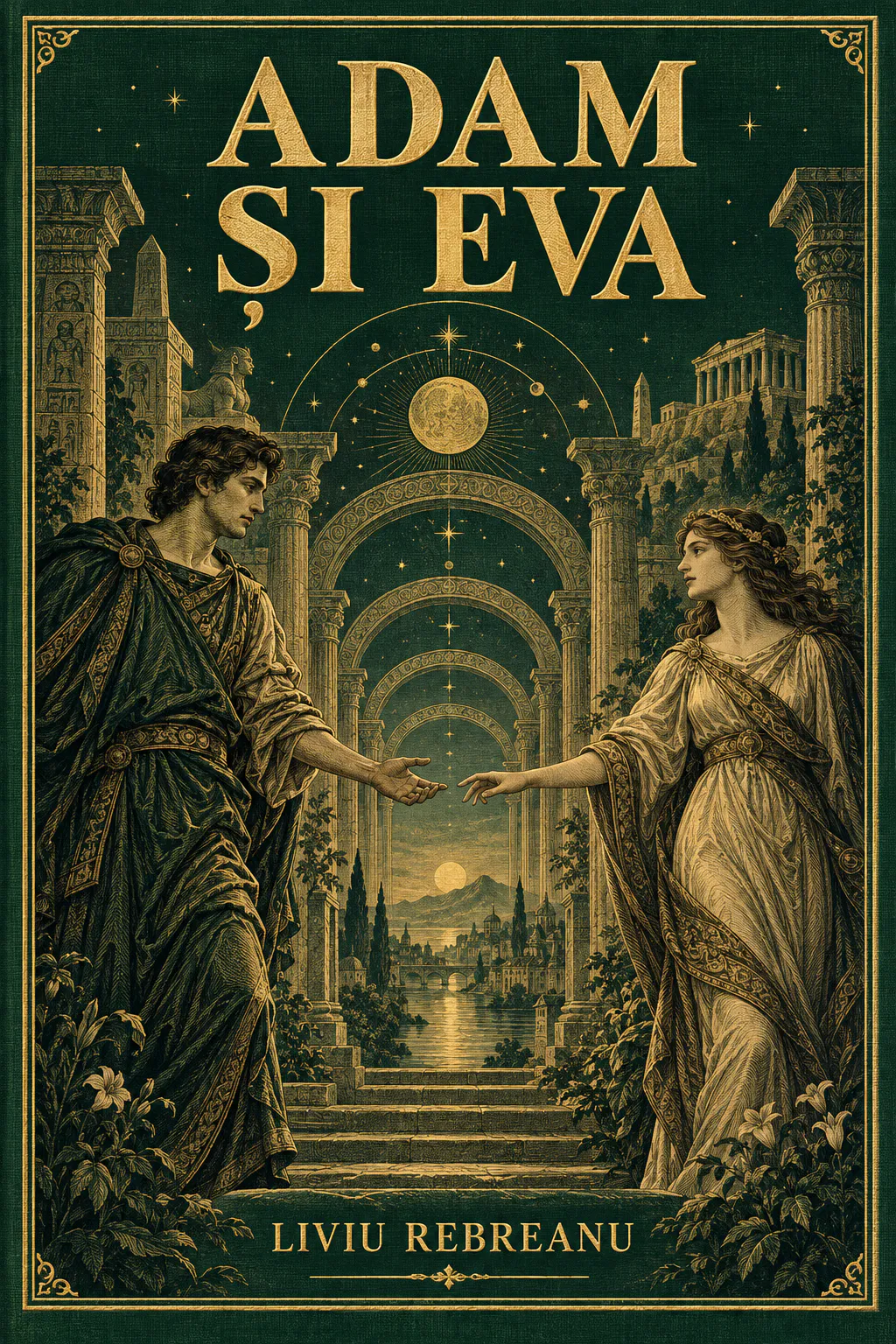
Adam și Eva
Toma Novac, a professor of philosophy, lies dying in a Bucharest hospital, shot by the husband of the woman he loves. In his last hours he lives again through seven earlier lives, across ancient civilisations and centuries of European history, and in each of them he meets and loses the same woman — the one soul made to complete his own.
About the book
Published in 1925, Adam și Eva is Liviu Rebreanu's most unusual novel: a story of love and reincarnation told in seven lives. It opens and closes at the deathbed of Toma Novac, and between those two frames come seven chapters, each named for the woman he loved in that life — Navamalika, Isit, Hamma, Servilia, Maria, Yvonne and Ileana. Built on the idea that every soul has one destined counterpart, which it may find but never keep, the novel moves from ancient India and Egypt through Rome and medieval Europe to the French Revolution and modern Bucharest. Rebreanu, best known for the hard realism of Ion and Pădurea spânzuraților, here turns to myth, mysticism and the history of civilisations. This edition is the original Romanian text.
Characters
Toma Novac — Protagonist
A professor of philosophy dying in a Bucharest hospital, who relives the seven earlier lives in which he found and lost the same woman.
Ileana — The woman Toma loves
The woman of his present life in Bucharest, the last form of the soul he has been seeking through the ages.
Navamalika — Ancient India
The woman he loves in his first life, in ancient India.
Isit — Ancient Egypt
The woman he loves in pharaonic Egypt.
Hamma — Mesopotamia
The woman he loves in the ancient cities of Mesopotamia.
Servilia — Ancient Rome
The woman he loves in imperial Rome.
Maria — Medieval Europe
The woman he loves in medieval Germany.
Yvonne — The French Revolution
The woman he loves in Paris during the Revolution.
About the author
Liviu Rebreanu (1885–1944) was a Romanian novelist and playwright, widely regarded as a founding figure of the modern Romanian novel. Known for his realism and psychological depth, he explored rural life, social inequality, and the conflicts between personal desire and moral responsibility. His most celebrated novels, Ion and Forest of the Hanged, remain essential works of Romanian literature.