
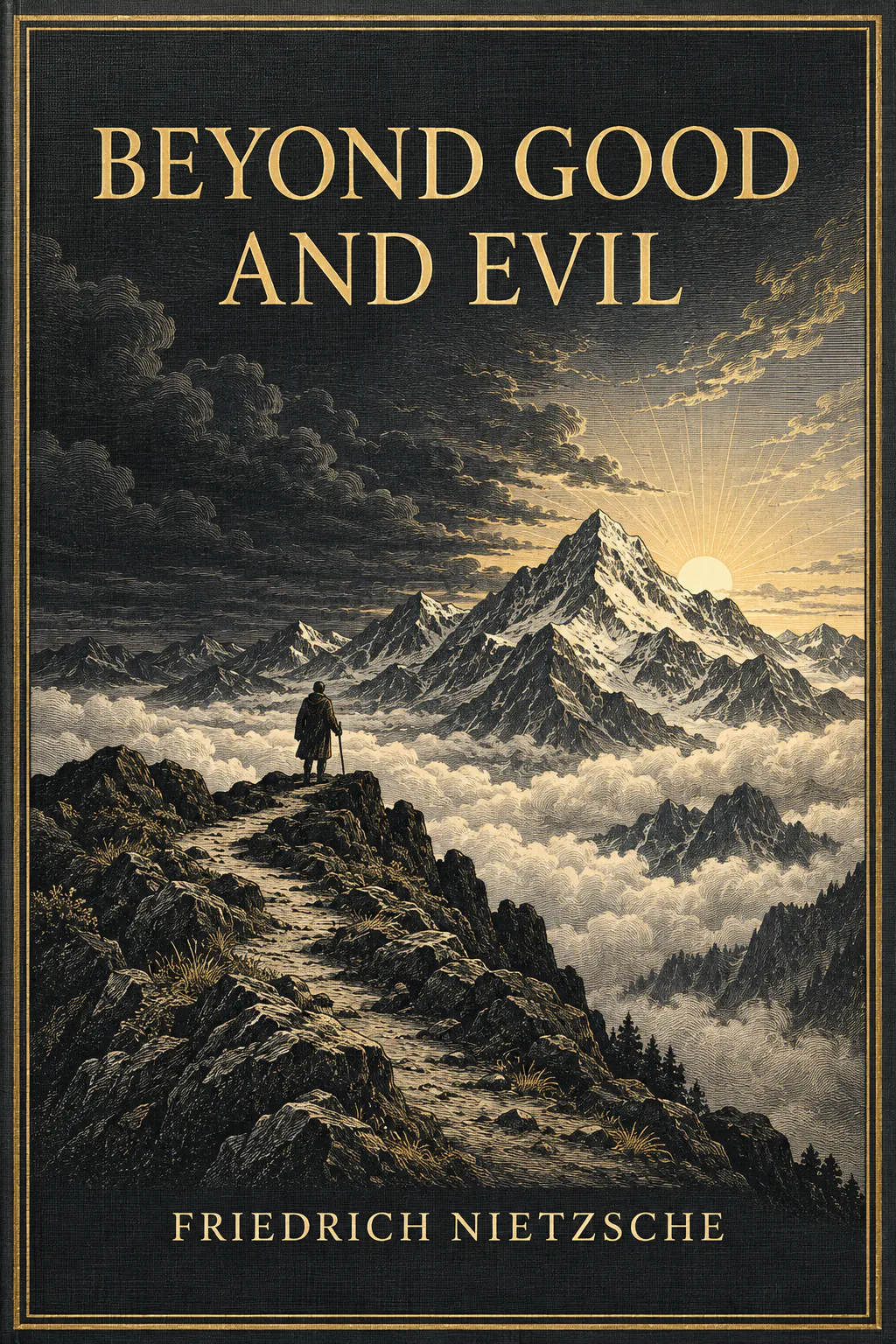
Beyond Good and Evil
Friedrich Wilhelm Nietzsche
Contains spoilers for the entire book.
Discussion topics
Topic 01 of 08
The prejudices of philosophers
Why does Nietzsche accuse past philosophers of dressing up their personal prejudices as objective truth?
Keep the conversation going
- What does he mean by the will to truth, and why does he question its value?
- Do you think any thinker can escape the charge he makes?
There is no single right answer. Bring your own reading.
Discussion topics
Why does Nietzsche accuse past philosophers of dressing up their personal prejudices as objective truth?
Keep the conversation going
- What does he mean by the will to truth, and why does he question its value?
- Do you think any thinker can escape the charge he makes?
Who are Nietzsche's free spirits, and how do they differ from the freethinkers of his day?
Keep the conversation going
- Why does he think a philosopher of the future must be dangerous?
- Would you want to be one of them?
What does Nietzsche mean by the will to power, and how far does he want to extend the idea?
Keep the conversation going
- Is it a description of life or a value he wants us to adopt?
- How did you respond to his claim that life itself is will to power?
How does Nietzsche distinguish master morality from slave morality?
Keep the conversation going
- Which of our everyday moral ideas does he say grew from resentment?
- Is his account a fair history, a provocation or both?
What does Nietzsche mean by herd morality, and why does he think it rules modern Europe?
Keep the conversation going
- Where do you see the herd instinct he describes?
- What does he want to put in its place?
How did reading Nietzsche in short sections and aphorisms affect your experience of the book?
Keep the conversation going
- Which aphorism in "Apophthegms and Interludes" struck you most?
- Does the form help or hinder his arguments?
What did you make of Nietzsche's sharp judgements on the Germans, the English, the French and the Jews?
Keep the conversation going
- How should we read those passages today?
- What does he hope a good European might be?
How does Nietzsche describe the noble soul in the final part, and does it attract or repel you?
Keep the conversation going
- What do you think it would mean to live beyond good and evil?
- Is Nietzsche's challenge to morality liberating, dangerous or both?
There is no single right answer. Bring your own reading.