
Das Schloß
Franz Kafka
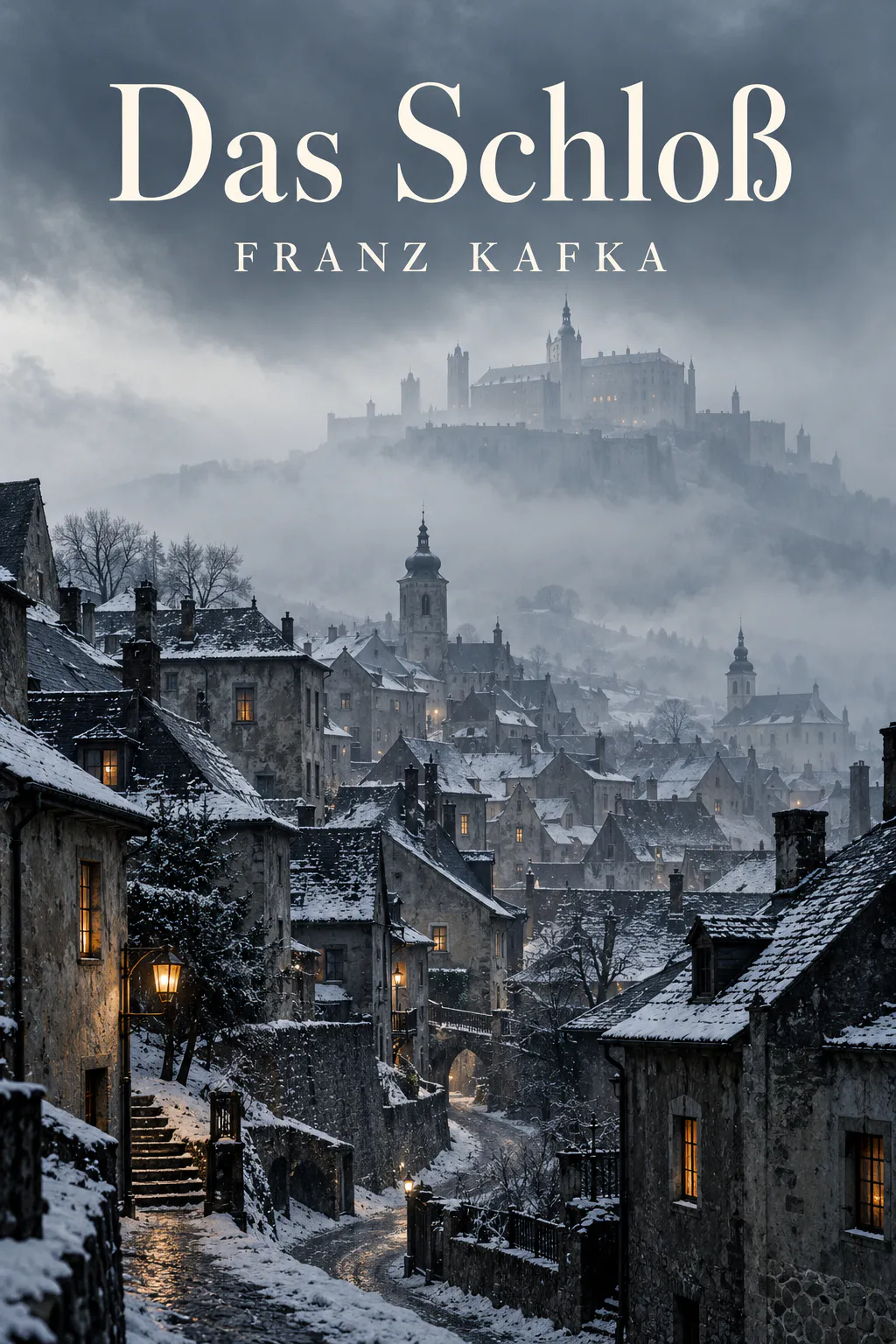
Das Schloß
Also in Romanian
A land surveyor known only as K. arrives one winter night in a village ruled from a castle on the hill, claiming he has been summoned to work there. The castle neither confirms nor denies it, and every attempt he makes to reach its officials — above all the mysterious Klamm — leads him deeper into rules, messengers and paperwork.
About the book
Das Schloß (The Castle) is Franz Kafka's third and last novel. He began it in 1922, abandoned it unfinished the same year, and it was published in 1926, two years after his death, by his friend Max Brod. K. struggles for recognition from an authority that is everywhere in the village and yet can never be reached, while his love affair with Frieda and his dealings with the family of the messenger Barnabas draw him into the village's own hierarchy of shame and favour. The manuscript breaks off in the middle of a sentence. With The Trial, it is the book behind much of what "Kafkaesque" has come to mean. This edition is the original German text of the 1926 first edition.
Characters
K. — The land surveyor
A stranger who arrives in the village one winter night, claiming the castle has hired him as a land surveyor, and who spends the novel trying to reach the authorities who could confirm it.
Frieda — Barmaid at the Herrenhof
Klamm's mistress, who leaves him and her place behind the bar to become K.'s fiancée.
Klamm — Castle official
A high official whom K. is determined to speak to in person. He is seen almost by no one, and everyone describes him differently.
The landlady — Landlady of the Brückenhof
Keeper of the inn where K. first lodges. She was once briefly Klamm's lover and has lived on that memory ever since; she distrusts K. from the start.
Barnabas — Messenger
A young man in a close-fitting white suit who brings K. letters from Klamm and seems to promise a way into the castle.
Olga — Barnabas's sister
She tells K. the long story of her family's fall from favour and of her own efforts to win it back.
Amalia — Barnabas's sister
Proud and silent, she tore up an official's obscene letter, and the whole village has shunned her family ever since.
Artur and Jeremias — K.'s assistants
Two identical young men sent from the castle as K.'s assistants, who follow him everywhere, imitate each other and are of no help at all.
The Mayor — Village mayor
Bedridden with gout, he explains to K. that the summons for a land surveyor was a mistake that the castle's offices never quite corrected.
The teacher — Village schoolteacher
A small, stiff man who brings K. the post of school janitor, the only work the village will offer him.
Hans Brunswick — A schoolboy
The shoemaker's son, who offers K. his help and through whom K. hopes to reach Hans's mother, who is said to come from the castle.
Momus — Klamm's village secretary
The official who wants to take down a record of K.'s conduct, which K. refuses to give.
Sortini — Castle official
The official whose letter to Amalia, and her answer to it, brought ruin on Barnabas's family.
Schwarzer — Son of an under-castellan
The young man who wakes K. on his first night in the inn and demands his permit to stay in the village.
Pepi — Maid at the Herrenhof
A young chambermaid at the Herrenhof, with a thick red-blonde plait.
Erlanger — Klamm's secretary
One of Klamm's first secretaries, a small man with a limp, famous for his memory.
About the author
Franz Kafka (1883–1924) was a German-speaking writer from Prague, then part of Austria-Hungary. He worked for most of his life at a workers' accident insurance institute and wrote in the evenings. Only a few of his stories appeared in his lifetime, among them The Metamorphosis, The Judgment and In the Penal Colony. His novels The Trial, The Castle and Amerika were published after his death by his friend Max Brod.