
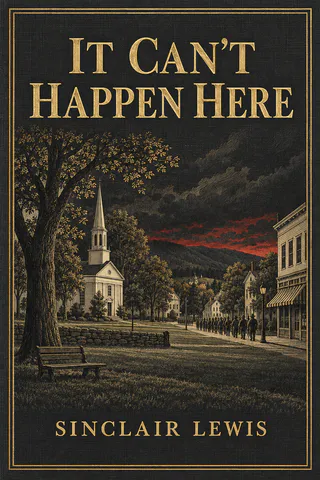
It Can't Happen Here
Sinclair Lewis
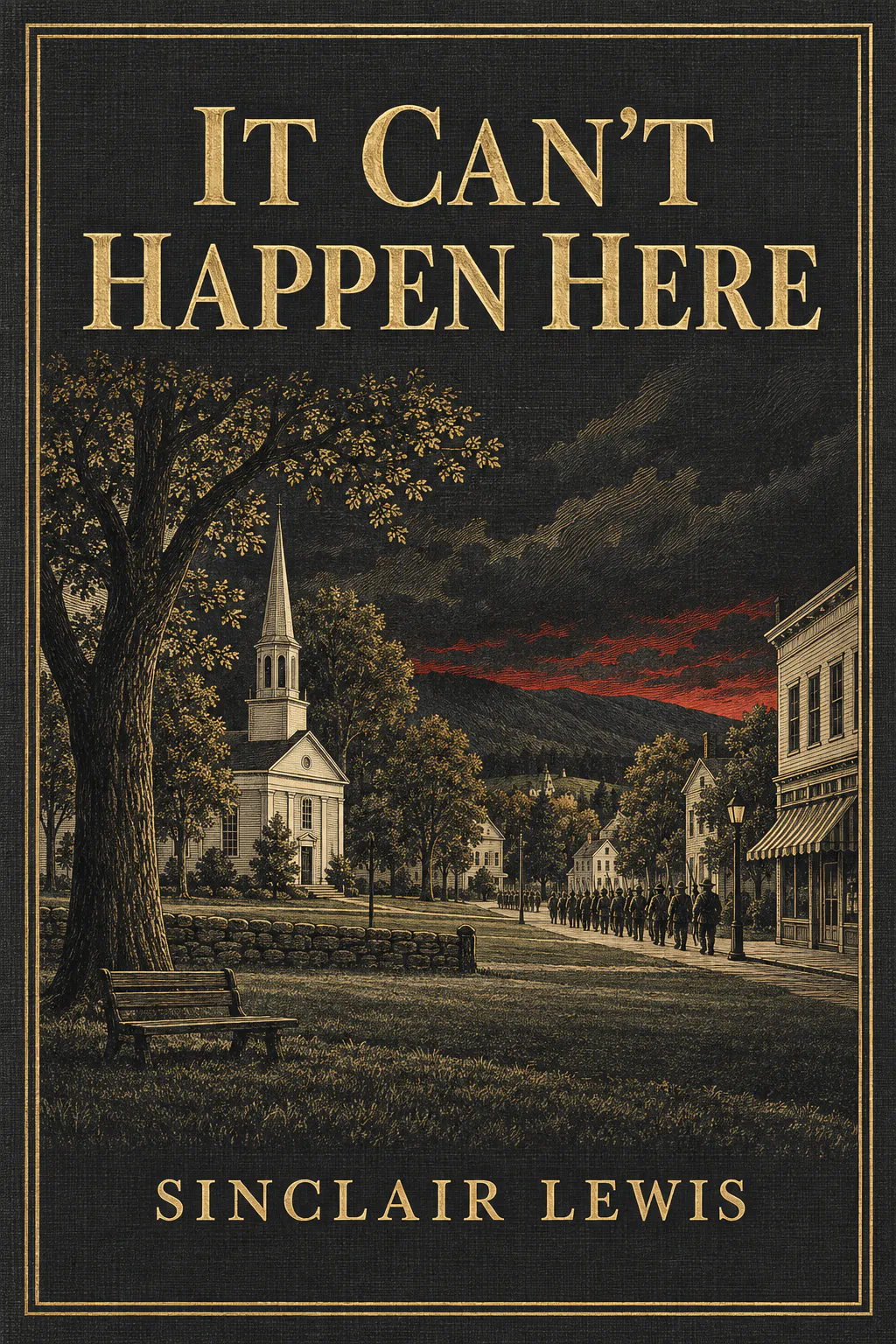
It Can't Happen Here
FictionHumor & SatireDystopian & Utopian FictionPolitics & Society
3.81from 26,586 ratingson Goodreads
In 1936 a folksy populist senator, Buzz Windrip, wins the American presidency on promises of prosperity and order, and within months the country is ruled by his militia. Doremus Jessup, a small-town Vermont newspaper editor, decides he can no longer keep quiet (1935).
Contains spoilers for the entire book
- Themes
- Atmosphere
About the book
Published in 1935, It Can’t Happen Here imagines the United States sliding into dictatorship after the populist senator Berzelius “Buzz” Windrip wins the presidency in 1936 on promises of prosperity and national renewal. Once in power, he backs his rule with a uniformed militia, the Minute Men, and begins to dismantle the constitution. Sinclair Lewis tells the story through Doremus Jessup, a liberal newspaper editor in a small Vermont town who watches neighbours, colleagues and institutions adapt to the new regime. Written as fascism rose in Europe, the novel is both a satire and a warning, aimed at the belief, expressed in its title, that democracy in America was safe from such a fate.
Characters
Doremus Jessup — Protagonist
A Vermont newspaper editor whose liberal convictions are tested by an authoritarian movement.
Berzelius (Buzz) Windrip — Politician
A charismatic demagogue who promises prosperity and national renewal while seeking unchecked power.
Lee Sarason — Political strategist
Windrip's calculating adviser and organizer, skilled at turning resentment into political machinery.
Lorinda Pike — Jessup's confidante
An independent hotel proprietor who shares Jessup's opposition to the new regime.
Shad Ledue — Local enforcer
Jessup's resentful hired man, attracted by the power the movement offers him.
Sissy Jessup — Jessup's daughter
Doremus's spirited younger daughter, whose political awareness grows as repression reaches the family.
About the author
Sinclair Lewis (1885–1951) was an American novelist, born in Sauk Centre, Minnesota, the son of a country doctor. After Yale he worked in journalism and publishing and wrote several novels that attracted little notice, until Main Street (1920), a satire of small-town Midwestern life, became a sensation. It was followed by Babbitt (1922), about a conformist businessman, whose name became a word for the type, Arrowsmith (1925), about a dedicated medical researcher, for which he declined the Pulitzer Prize, Elmer Gantry (1927), about a fraudulent preacher, and Dodsworth (1929). In 1930 he became the first American to receive the Nobel Prize in Literature. He was married for some years to the journalist Dorothy Thompson, whose reporting on Nazi Germany informed It Can’t Happen Here (1935). His later work was less successful, and after years of heavy drinking he died in Rome in 1951.