
Lost Horizon
James Hilton
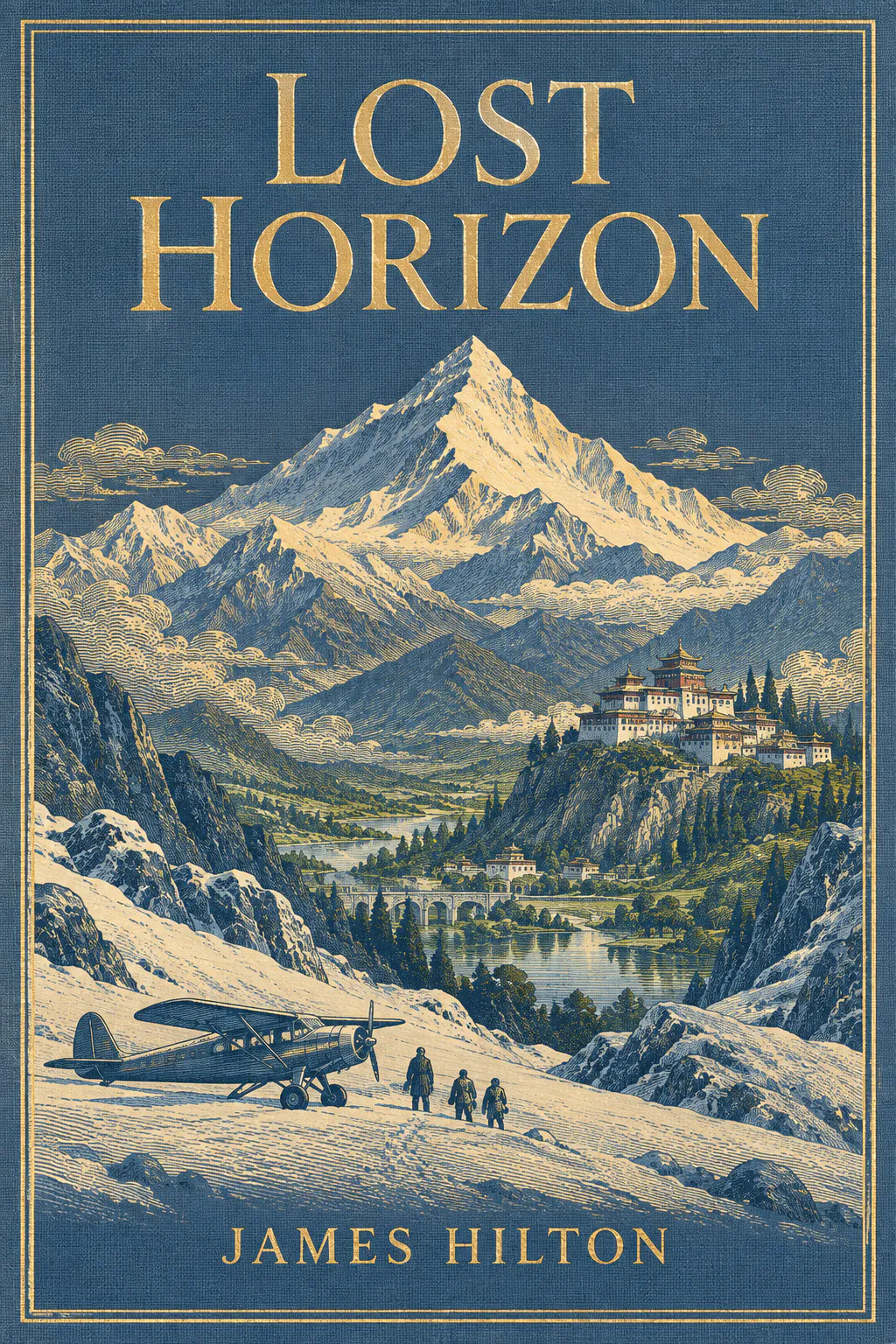
Lost Horizon
FictionAdventureFantasyDystopian & Utopian Fiction
3.95from 26,114 ratingson Goodreads
In 1931 a plane evacuating four Westerners from a rebellion in India is hijacked and flown deep into the mountains of Tibet. They are taken in at Shangri-La, a lamasery in a sheltered valley where no one seems to grow old, and where it is not clear they will ever be allowed to leave (1933).
Contains spoilers for the entire book
- Themes
- Atmosphere
About the book
Published in 1933, Lost Horizon tells how Hugh Conway, a British consul, and three other passengers are evacuated by air from an uprising in India, only to have their plane hijacked and flown deep into Tibet. They are brought to Shangri-La, a lamasery in a hidden valley beneath a great mountain, where life is calm, comfortable and strangely long. James Hilton frames the story as a tale recounted by Conway’s acquaintances, who are never quite sure what to believe. The novel set a mood of escape from a world heading towards another war, and its imagined lamasery gave the English language a word for an earthly paradise.
Characters
Hugh Conway — Protagonist
A British consular official whose forced journey to Shangri-La awakens a longing for peace and purpose.
Mallinson — Conway's colleague
A younger British official impatient to escape the mysterious valley and return to ordinary life.
Miss Brinklow — Missionary
A fellow passenger whose practical religious convictions remain firm in the unfamiliar setting.
Henry D. Barnard — American traveler
An outgoing passenger whose interest in Shangri-La is shaped by his own unsettled past.
Chang — Guide and host
The courteous representative of the lamasery who introduces the travelers to its customs.
The High Lama — Spiritual leader
The secluded head of Shangri-La, whose conversations with Conway reveal the community's purpose.
Lo-Tsen — Resident of Shangri-La
A poised young musician whose presence affects the travelers' understanding of the valley.
About the author
James Hilton (1900–1954) was an English novelist and screenwriter, born in Leigh, Lancashire, the son of a schoolmaster. He was educated at The Leys School and at Christ’s College, Cambridge, and published his first novel, Catherine Herself, in 1920, while still a student. For more than a decade he worked as a journalist and reviewer while writing novels that sold modestly, until Lost Horizon (1933), which won the Hawthornden Prize, and Goodbye, Mr. Chips (1934), drawn partly on his school and on his father, made him internationally famous. Lost Horizon later became the first title of the American paperback publisher Pocket Books. Hilton moved to Hollywood in the late 1930s, where several of his books were filmed, and he shared an Academy Award for the screenplay of Mrs. Miniver (1942). His later novels include Random Harvest (1941). He died in Long Beach, California, in 1954.