
On the Origin of Species by Means of Natural Selection: or the Preservation of Favoured Races in the Struggle for Life. (2nd edition)
Charles Darwin
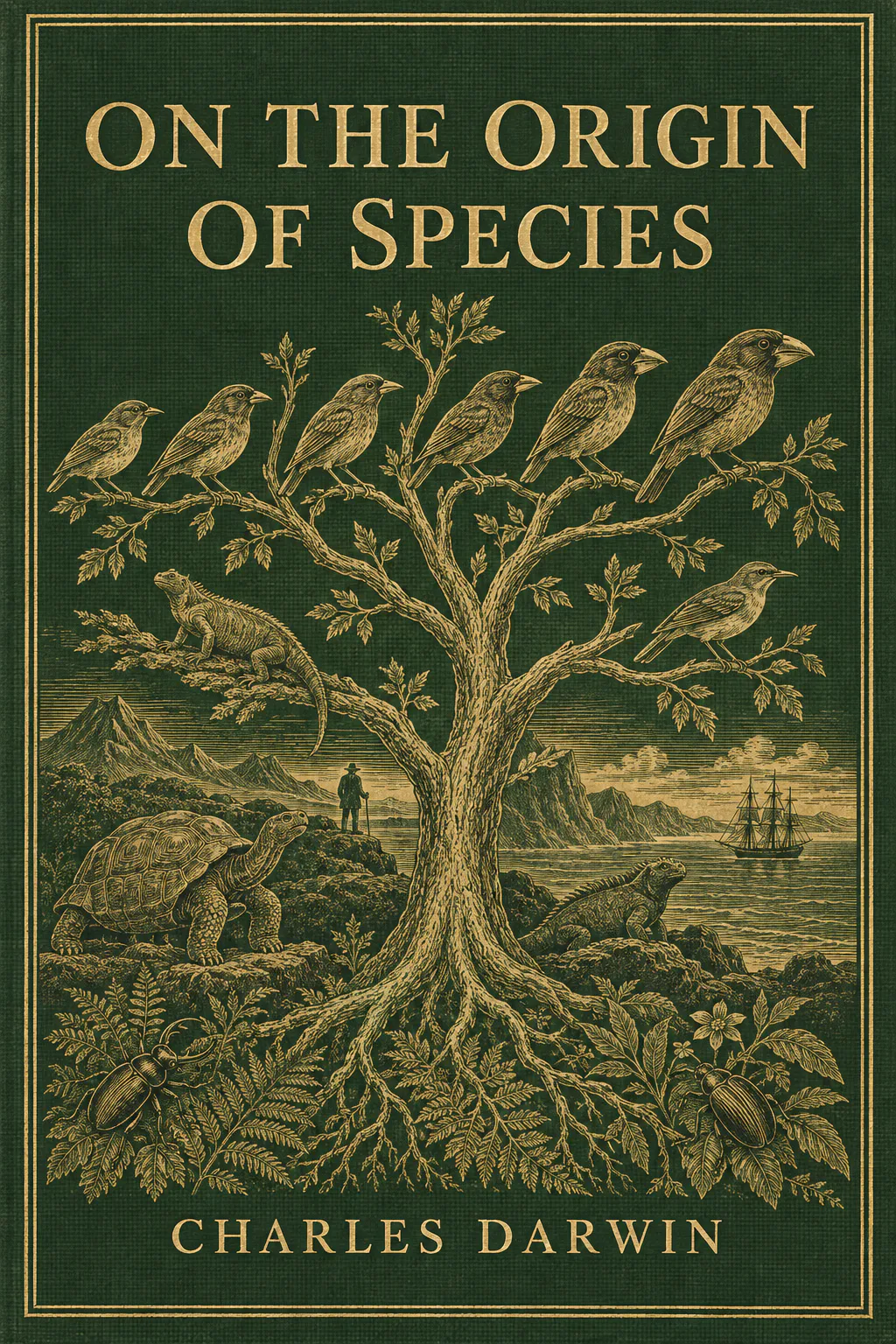
On the Origin of Species by Means of Natural Selection: or the Preservation of Favoured Races in the Struggle for Life. (2nd edition)
ClassicsNonfictionScience & TechnologyNature & Animals
4.01from 124,410 ratingson Goodreads
"On the Origin of Species by Means of Natural Selection" by Charles Darwin is a work of scientific literature published in 1859. This foundational text introduced the theory that populations evolve through natural selection, presenting evidence that life's diversity arose from common descent through branching evolution. Drawing on Darwin's research and Beagle expedition findings, the book challenged prevailing beliefs about unchanging species and humanity's unique place in nature, sparking intense scientific, philosophical, and religious debate that transformed biology forever.
Contains spoilers for the entire book
- Themes
- Atmosphere
About the book
On the Origin of Species was first published in November 1859, and its first printing sold out at once; this second edition followed in January 1860, with corrections. In it Charles Darwin sets out the theory of evolution by natural selection, drawing on decades of observation, including his voyage on HMS Beagle, his correspondence with breeders and naturalists, and his own experiments. Darwin begins with the variation produced by breeders of pigeons and livestock, then argues that a similar but far slower process works in nature, as individuals better suited to their conditions leave more offspring. He devotes whole chapters to the objections he expected, and ends with his image of “endless forms most beautiful” descending from a few common origins.
Characters
The rock-pigeon — The common ancestor
The wild pigeon from which Darwin argues all the fancy breeds of domestic pigeon descend.
Alfred Russel Wallace — The co-discoverer
The naturalist who reached the same theory independently, as Darwin acknowledges in his introduction.
Sir Charles Lyell — The geologist
Whose account of slow, gradual change in the earth’s surface underpins Darwin’s sense of geological time.
Dr. Hooker — The botanist
Joseph Dalton Hooker, the friend whose knowledge of plants and their distribution Darwin draws on throughout.
Thomas Malthus — The source of the struggle
Whose doctrine of population, applied to the whole animal and vegetable kingdoms, gives Darwin the struggle for existence.
The Galapagos species — The island evidence
The birds and plants of the archipelago, each island with its own forms, related to those of South America.
About the author
Charles Darwin (1809–1882) was an English naturalist, born in Shrewsbury into a prosperous family; his grandfathers were the physician and poet Erasmus Darwin and the potter Josiah Wedgwood. He abandoned medical studies at Edinburgh, and was studying at Cambridge with a view to becoming a clergyman when he was invited to sail as a naturalist aboard HMS Beagle. Its voyage round the world from 1831 to 1836, including its visit to the Galápagos Islands, gave him the observations on which he would build for the rest of his life. Settled with his wife Emma at Down House in Kent, he worked for two decades on his theory of evolution by natural selection, and published On the Origin of Species in 1859, after Alfred Russel Wallace reached similar ideas. His later books include The Descent of Man (1871). He is buried in Westminster Abbey.