
Sărmanul Dionis
Mihai Eminescu
Sărmanul Dionis
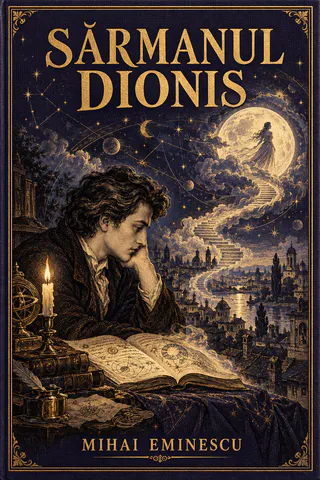
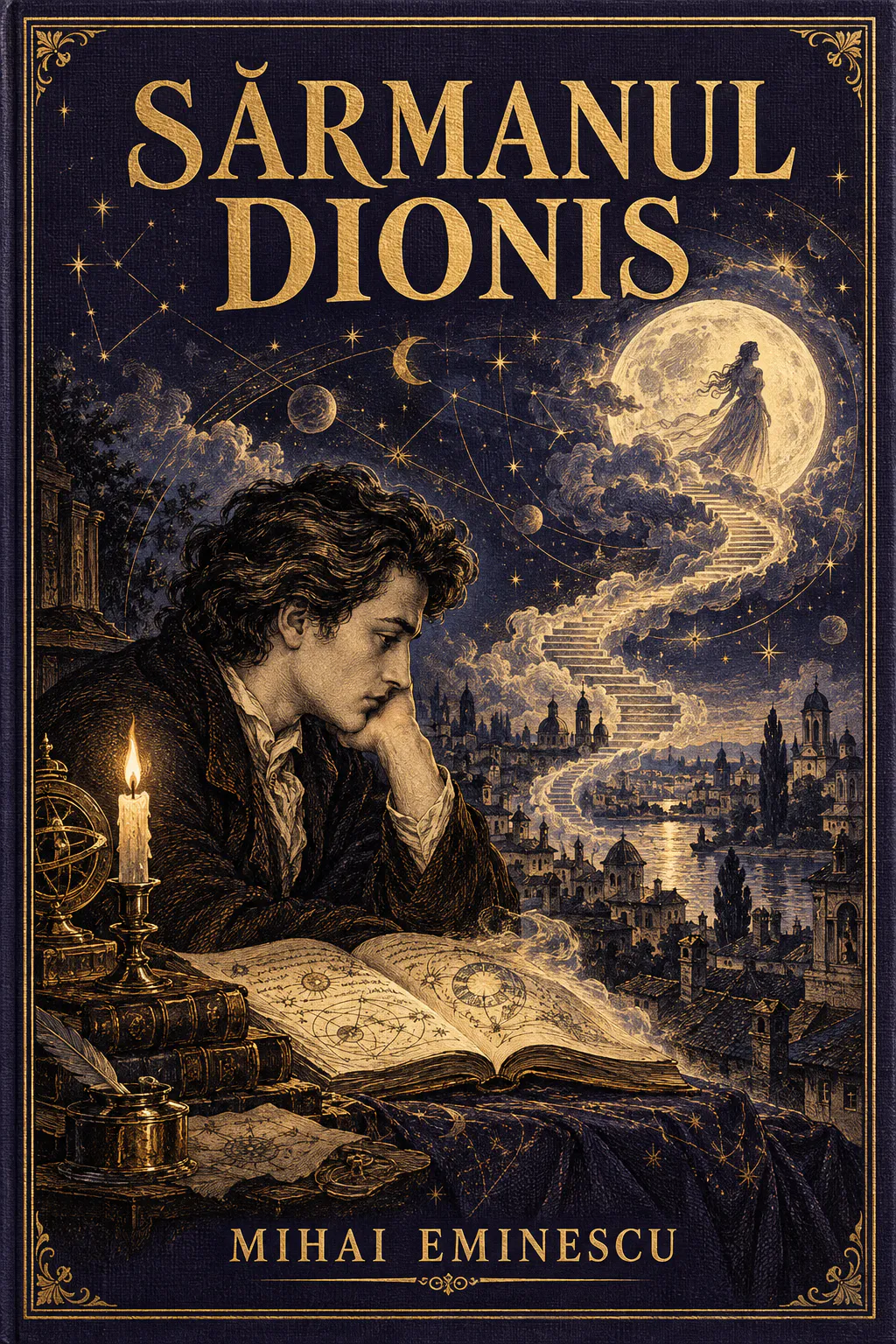
Dionis, a poor young dreamer in a cold attic room, broods over a strange old book of astrology and the idea that time and space exist only inside the mind. One night he falls asleep and wakes as Dan, a young monk in medieval Moldavia, apprenticed to a mysterious master who teaches him to escape his own body — and the journey that follows carries him, with the girl he loves, as far as the moon.
About the book
Sărmanul Dionis (Poor Dionis) appeared in Convorbiri literare in December 1872 and January 1873, the only novella Mihai Eminescu published in his lifetime. It is one of the founding works of the fantastic in Romanian literature. The story moves between two lives: that of Dionis, a penniless young man of Eminescu's own time, and that of Dan, a monk in the age of Alexandru cel Bun, who learns from his master Ruben the secret of living outside time. Drawing on Kant's idea that time and space are forms of the mind, on astrology and on the doctrine of reincarnation, Eminescu turns a philosophical question into a dreamlike adventure of love, pride and fall, written in the lyrical prose of Romania's greatest poet. This edition is the original Romanian text.
Characters
Dionis — Protagonist
A poor young dreamer in a cold attic, absorbed in an old book of astrology and the idea that time and space are inside the mind.
Dan — Dionis's earlier self
A young monk in medieval Moldavia, the life Dionis wakes into, who learns to step outside his own body.
Ruben — Dan's master
A mysterious, learned master who teaches Dan the secret of living outside time.
Maria — The girl he loves
The girl Dionis loves, who goes with him on his dreamlike journey as far as the moon.
About the author
Mihai Eminescu (1850–1889) was a Romanian poet, prose writer and journalist, generally regarded as the national poet of Romania. Born in Botoșani in Moldavia, he studied in Vienna and Berlin, worked as a librarian, school inspector and newspaper editor, and was a central figure of the Junimea literary society. His poems — among them Luceafărul, Scrisorile and Glossă — shaped the modern Romanian literary language, and his prose, including Sărmanul Dionis, brought Romantic philosophy and the fantastic into Romanian fiction. He spent his last years in illness and died in Bucharest at the age of thirty-nine.