
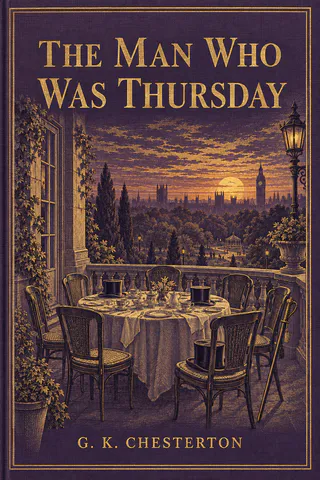
The Man Who Was Thursday: A Nightmare
G. K. (Gilbert Keith) Chesterton
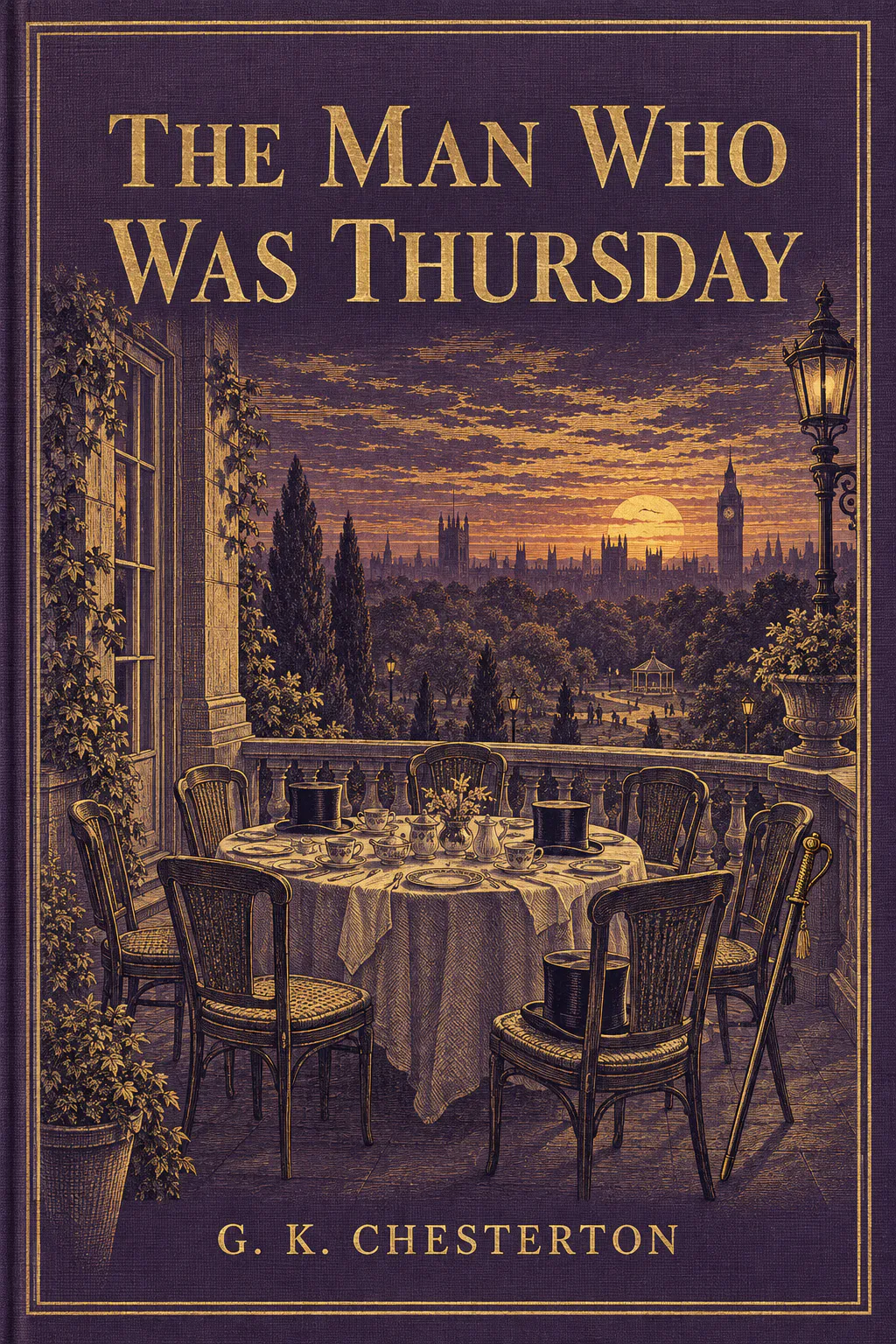
The Man Who Was Thursday: A Nightmare
G. K. (Gilbert Keith) Chesterton
FictionAdventureMysteryClassicsFantasy
15 chapters·6h 38m listening
3.82from 48,566 ratingson Goodreads
"The Man Who Was Thursday: A Nightmare" by G. K. Chesterton is a philosophical novel with elements of adventure and satire, written in the late 19th century. The story revolves around the enigmatic character Gabriel Syme, a police detective who infiltrates a group of anarchists in London to uncover their plans and identities. As the narrative unfolds, it explores complex themes of order, chaos, and the nature of evil, often through witty dialogue and absurd situations that challenge conventional thinking. At the start of the novel, readers are introduced to the suburb of Saffron Park, with its colorful and eccentric inhabitants, primarily poets and artists. One evening, during a striking sunset, the anarchistic poet Lucian Gregory meets Gabriel Syme, who surprises him with bold arguments in favor of law and order, challenging Gregory's views. Their conversation escalates into a duel of ideologies when Gregory reveals his deep commitment to anarchism, which leads to a confrontation between the two. In a twist of fate, Syme's true identity as a detective is disclosed, and as he joins the anarchists disguised as one of them, the stage is set for a profound exploration of the philosophical conflict between chaos and structure in society.
Contains spoilers for the entire book
- Themes
- Atmosphere
About the book
Published in 1908 with the subtitle A Nightmare, The Man Who Was Thursday follows Gabriel Syme, a poet recruited into a secret branch of the police to fight anarchism. Through a chance meeting he is elected to the Central Anarchist Council, whose seven members go by the names of the days of the week, and takes the place of Thursday. G. K. Chesterton begins with the trappings of a thriller, with disguises, pursuits and a dynamite plot, and lets the story turn steadily stranger as Syme discovers more about his fellow councillors and their enormous president, Sunday. Funny and dreamlike, the novel becomes a fantasy about doubt, order and faith.
Characters
Gabriel Syme — Protagonist
A poet and undercover policeman who enters a secret anarchist council under the name Thursday.
Sunday — Council president
The imposing and enigmatic head of the council, whose motives resist Syme's explanations.
Lucian Gregory — Anarchist poet
An outspoken revolutionary whose argument with Syme opens the way into the conspiracy.
The Marquis de St. Eustache — Wednesday
A flamboyant member of the council whose conduct draws Syme's suspicion.
Professor de Worms — Friday
An apparently decrepit council member whose behavior unsettles Syme's assumptions.
Dr. Bull — Saturday
A smiling council member whose dark glasses make his intentions difficult to read.
About the author
G. K. (Gilbert Keith) Chesterton
G. K. Chesterton (1874–1936) was an English writer, born in Kensington, London. After studying art at the Slade School he turned to journalism, and became one of the most prolific and popular writers of his day, producing essays, poems, novels, biographies and literary criticism, as well as a weekly column for decades. He is best remembered for the Father Brown stories, about an unassuming Catholic priest who solves crimes through his understanding of human nature, which began with The Innocence of Father Brown (1911), and for the novels The Napoleon of Notting Hill (1904) and The Man Who Was Thursday (1908). In Orthodoxy (1908) and The Everlasting Man (1925) he defended Christian belief, and in 1922 he was received into the Catholic Church. Famous for his paradoxes and his good-humoured public debates with George Bernard Shaw and H. G. Wells, he died at Beaconsfield in 1936.