
A Tale of Two Cities
Charles Dickens
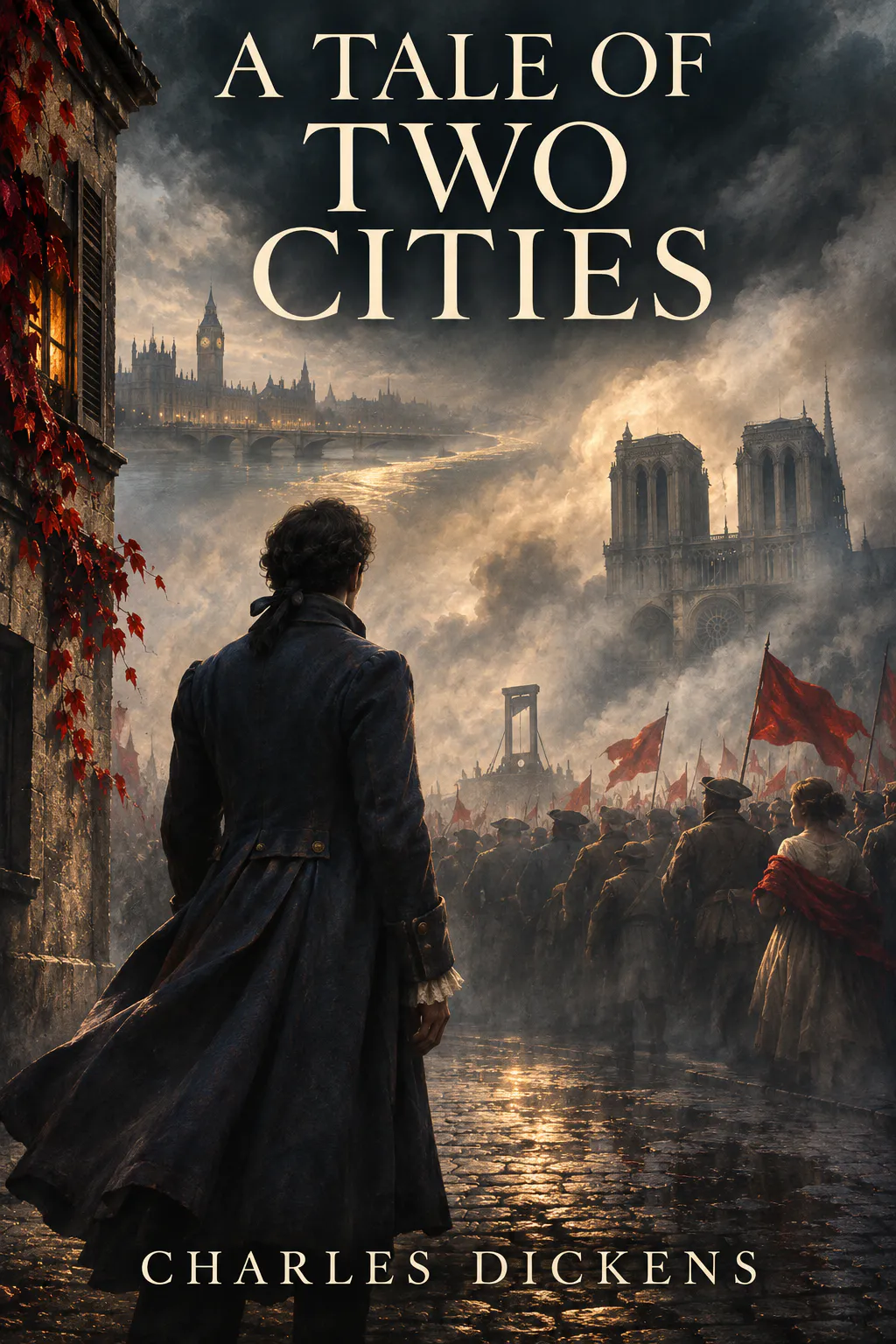
A Tale of Two Cities
FictionHistorical FictionWar Fiction
Also in Romanian
3.88from 1,035,648 ratingson Goodreads
"A Tale of Two Cities" by Charles Dickens is a historical novel published in 1859. Set in London and Paris during the tumultuous French Revolution, it follows Dr. Alexandre Manette after his mysterious 18-year imprisonment in the Bastille and his reunion with his daughter Lucie. Their lives become entangled with a French aristocrat fleeing his heritage and a dissolute English lawyer who harbors secret devotion. Against the backdrop of revolutionary terror and violence, personal sacrifices and hidden connections shape their intertwined fates.
Contains spoilers for the entire book
- Themes
- Atmosphere
About the book
A Tale of Two Cities was the first novel Dickens published in All the Year Round, the weekly magazine he founded in 1859, where it ran from April to November of that year. It opens in 1775, when Jarvis Lorry, a man of business at Tellson’s Bank, travels to Paris with a young Englishwoman, Lucie Manette, to bring home the father she has always believed dead: Doctor Manette, released after eighteen years in the Bastille, who has forgotten everything but the shoemaking he learned in his cell. Back in London, the family’s quiet lodgings near Soho become the centre of the story, drawing in Charles Darnay, a French émigré who has given up his family’s name and lands, and Sydney Carton, a gifted, dissolute barrister who looks uncannily like him and believes his own life to be wasted. Across the Channel, in the wine-shop of Ernest Defarge in the poor quarter of Saint Antoine, the Revolution is gathering, and Madame Defarge sits knitting the names of those who will pay for it. When the storm breaks and an old debt calls Darnay back to Paris, every thread of the story is drawn into the Terror. Dickens took the idea while acting in Wilkie Collins’s play The Frozen Deep and leaned on Carlyle’s history of the Revolution for its events; the result, with its famous first and last lines, is one of the best-selling novels ever written.
Characters
Sydney Carton — Barrister
A brilliant, dissipated English barrister who does the thinking for Stryver, holds his own life cheap and loves Lucie Manette without hope.
Charles Darnay — French émigré
A French aristocrat who renounces the name and wealth of the Evrémondes, earns his living in England teaching French, and marries Lucie.
Lucie Manette — Doctor Manette’s daughter
The golden-haired daughter whose devotion restores her father to himself and binds together everyone who loves her, the golden thread of the second book.
Doctor Alexandre Manette — Physician
A French doctor freed after eighteen years in the Bastille, where he learned to make shoes to keep his mind from breaking, and recalled to life by his daughter.
Jarvis Lorry — Banker at Tellson’s
A methodical, kind-hearted man of business who insists he has no feelings, brings Lucie to her father, and becomes the family’s most faithful friend.
Ernest Defarge — Wine-shop keeper
The keeper of a wine-shop in Saint Antoine, once Doctor Manette’s servant, and one of the leaders of the Revolution in his quarter.
Madame Defarge — Revolutionary
Defarge’s wife, who knits into her register the names of those the Revolution will condemn and nurses an unappeasable hatred of the Evrémondes.
Miss Pross — Lucie’s companion
Lucie’s fierce, red-haired English companion, devoted to her “Ladybird” and ready to fight anyone in her defence.
Jerry Cruncher — Tellson’s messenger
An odd-job man at Tellson’s Bank who works a grim second trade by night and accuses his praying wife of “flopping” against him.
C. J. Stryver — Barrister
A loud, shouldering barrister who rises on the work Sydney Carton does for him and believes himself a splendid match for Lucie.
The Marquis St. Evrémonde — Aristocrat
Darnay’s uncle, a cold and cruel nobleman of the old regime whose carriage runs down a child in the streets of Saint Antoine.
John Barsad — Spy
An informer who swears against Darnay at his trial in London and turns up again in Paris as a spy in the prisons of the Republic.
About the author
Charles Dickens (1812–1870) was the defining English novelist of the Victorian age and, in his own lifetime, its most famous writer. When his father was imprisoned for debt the twelve-year-old Dickens was sent to work in a blacking factory, and the experience runs under everything he wrote about childhood, poverty and institutions that fail the people in them. Publishing in monthly instalments, he wrote for an audience that read each part as it appeared, which is part of why his books are built of cliffhangers and crowds of minor characters nobody forgets. His novels include Oliver Twist, David Copperfield, Bleak House, Great Expectations and A Christmas Carol.