
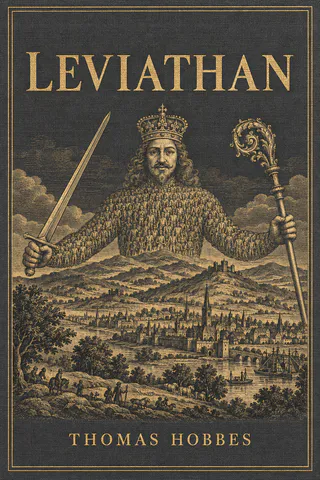
Leviathan
Thomas Hobbes
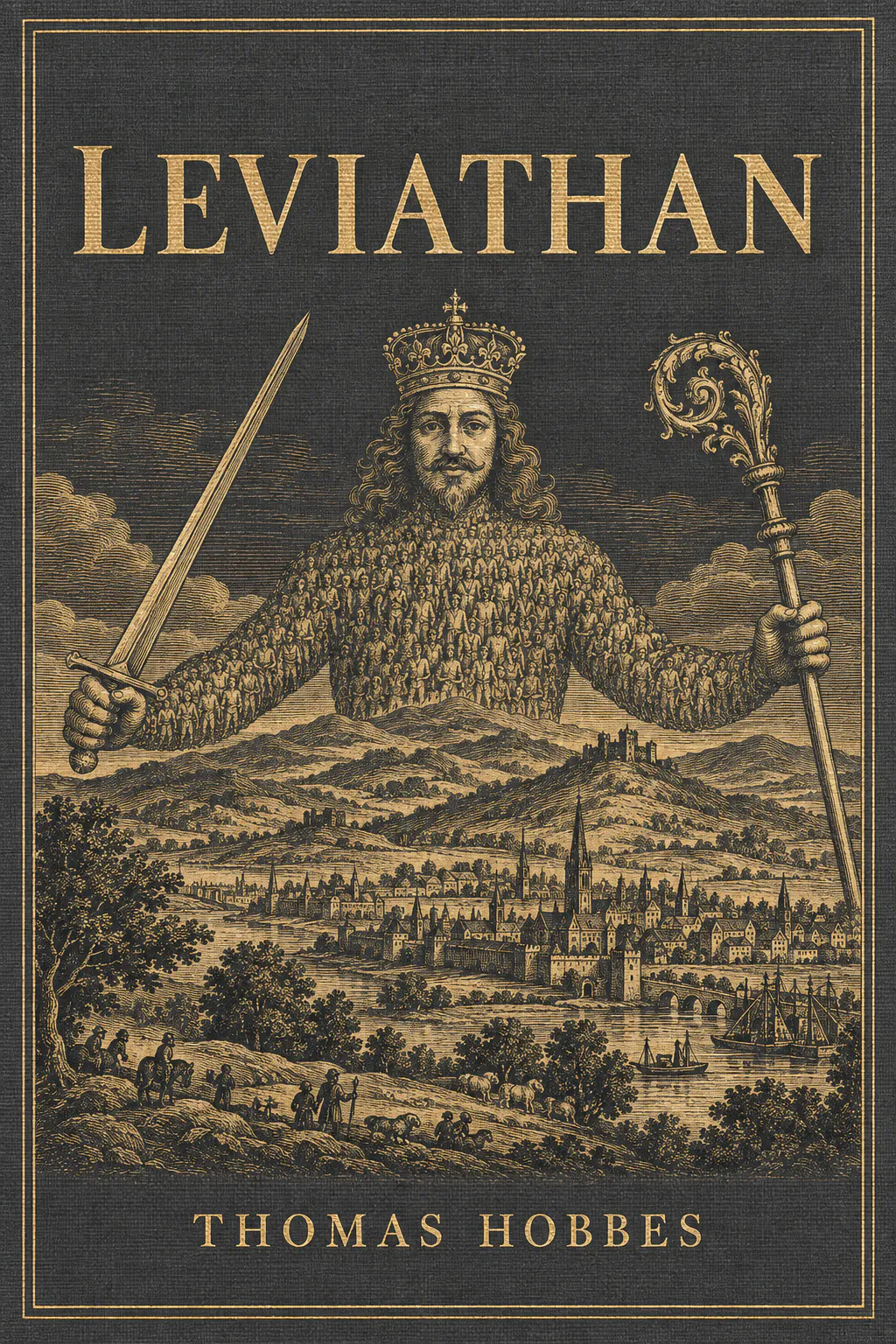
Leviathan
ClassicsNonfictionPhilosophyPolitics & Society
3.70from 54,847 ratingson Goodreads
"Leviathan" by Thomas Hobbes is a philosophical treatise published in 1651. Written during the English Civil War, it explores the structure of society and legitimate government through social contract theory. Hobbes argues that humanity's natural state is a brutal "war of all against all," driven by individual appetites and the fear of violent death. Only a strong, absolute sovereign can prevent civil war and chaos by uniting both secular and spiritual power. This influential work presents a materialistic view of human nature and political order.
Contains spoilers for the entire book
- Themes
- Atmosphere
About the book
Published in 1651, Leviathan was written by Thomas Hobbes in exile in Paris, as civil war tore England apart. It begins with human nature and argues that without a common power to keep them in awe, people would live in a war of all against all, in which life would be, in its most famous phrase, “solitary, poor, nasty, brutish, and short”. From that condition Hobbes derives the case for a social contract, by which people surrender their natural liberty to a sovereign strong enough to keep the peace. Its four parts move from psychology and language to the commonwealth, religion and the authority of the Church. The book’s frontispiece, a giant ruler whose body is made of his subjects, has become an emblem of modern political thought.
Characters
The Sovereign — The Leviathan
The person or assembly to whom all surrender their right of self-government, the “mortal god” whose power keeps them in peace.
The Fool — The objector
The one who says in his heart that there is no such thing as justice, and that breaking a covenant can be reasonable; Hobbes answers him.
The savage people of America — The state of nature
Hobbes’s example of people living without a common power, offered as evidence of what life is like outside the commonwealth.
Aristotle — The old authority
The philosopher whose influence on the universities Hobbes blames for much of the confusion in philosophy, politics and religion.
The Pope — The Kingdom of Darkness
The claimed spiritual power that Hobbes, in the book’s last part, sees as a rival to the sovereign and a source of darkness in Christendom.
About the author
Thomas Hobbes (1588–1679) was an English philosopher, born in Westport, near Malmesbury in Wiltshire, in the year of the Spanish Armada; he later said that his mother, frightened by rumours of the invasion, gave birth to twins, himself and fear. After studying at Oxford he spent most of his life in the service of the Cavendish family, the earls of Devonshire, as tutor, secretary and companion, travelling widely in Europe and meeting Galileo. His first published work was a translation of Thucydides (1629). Fearing for his safety as civil war approached, he went to Paris in 1640, where he tutored the exiled future Charles II in mathematics and wrote Leviathan (1651). Back in England, his views made him suspected of atheism, and he was drawn into long disputes over geometry. Still writing in his eighties, he translated Homer’s Iliad and Odyssey, and died at Hardwick Hall in 1679, aged ninety-one.