
North and South
Elizabeth Cleghorn Gaskell
North and South
FictionRomanceFamily & Domestic FictionPolitics & Society
53 chapters·19h 3m listening·Also in Romanian
4.15from 190,122 ratingson Goodreads
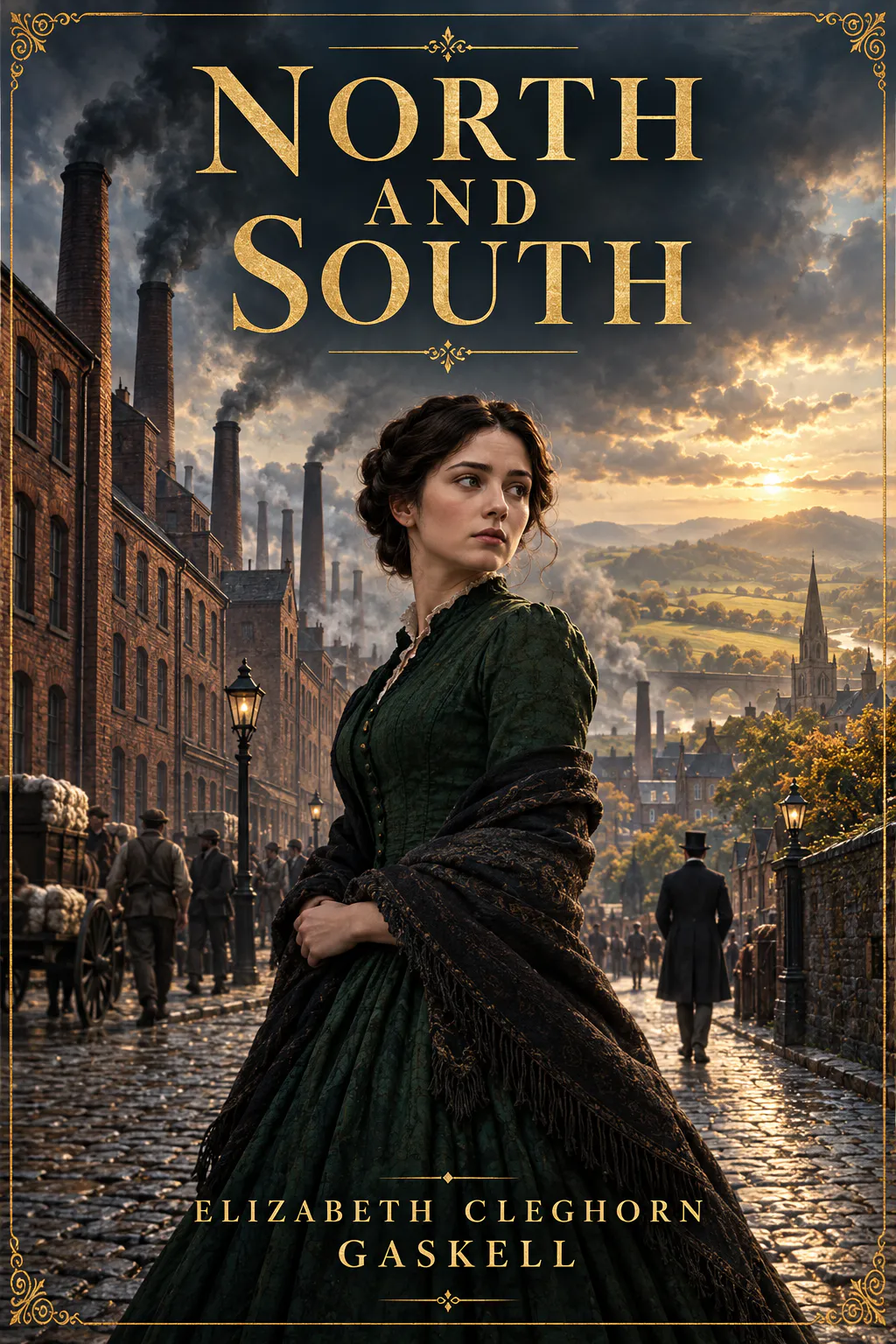
"North and South" by Elizabeth Cleghorn Gaskell is a social novel published in 1854–55. When Margaret Hale is forced to leave her peaceful rural home in southern England for the industrial town of Milton, she confronts the harsh realities of the Industrial Revolution. She witnesses bitter clashes between mill owners and workers during the first strikes, and finds herself in conflict with John Thornton, a proud cotton-mill owner who scorns his laborers. The novel explores her evolving understanding of industrial society and her complicated relationship with Thornton.
Contains spoilers for the entire book
- Themes
- Atmosphere
About the book
First published as a serial in Charles Dickens’s Household Words in 1854–1855, and as a book in 1855, North and South follows Margaret Hale, a clergyman’s daughter, after her father leaves the Church of England over a matter of conscience and moves the family from the southern village of Helstone to Milton, a cotton-manufacturing town in the north. There she meets John Thornton, a self-made mill-owner who comes to her father for lessons in the classics, and Nicholas Higgins, a mill hand and union man, whose daughter Bessy is dying of the dust of the carding rooms. Gaskell lived in Manchester, the city Milton is drawn from, and wrote about it from close knowledge. The novel sets the settled assumptions of the rural south against the energy and hardship of the industrial north, and weighs masters against workers through a strike and what follows it. Margaret’s prejudice and Thornton’s pride make the relationship between them one of the book’s central threads. Gaskell wanted to call the novel Margaret Hale; the title it carries was Dickens’s choice.
Characters
Margaret Hale — Protagonist
A clergyman’s daughter, brought up partly in London with her cousin Edith, whose southern pride is tested when her family moves to the northern mill town of Milton.
John Thornton — Mill-owner
The master of Marlborough Mills, a self-made man who rose from hardship and holds firm views on the rights of masters over their hands.
Mr Hale — Margaret’s father
The gentle, scholarly vicar of Helstone, whose religious doubts lead him to give up his living and become a private tutor in Milton.
Mrs Hale — Margaret’s mother
Margaret’s mother, who has long felt Helstone beneath her hopes and finds Milton’s smoke and manners harder still to bear.
Mrs Thornton — Thornton’s mother
John Thornton’s formidable mother, fiercely proud of her son and quick to judge the Hales’ southern daughter.
Fanny Thornton — Thornton’s sister
Thornton’s younger sister, fond of comfort and fashion and embarrassed by the mills that pay for them.
Nicholas Higgins — Mill hand and union man
A Milton weaver and committed union man whose blunt talk and friendship show Margaret the town from the workers’ side.
Bessy Higgins — Higgins’s daughter
Nicholas’s elder daughter, a young woman made ill by the cotton fluff of the carding room, who becomes Margaret’s first friend in Milton.
Frederick Hale — Margaret’s brother
Margaret’s elder brother, a naval officer who cannot come home to England after taking part in a mutiny.
Edith Shaw — Margaret’s cousin
Margaret’s pretty, good-natured cousin, whose wedding to Captain Lennox opens the novel.
Mrs Shaw — Margaret’s aunt
Edith’s mother and Mrs Hale’s sister, a comfortable London widow in whose house Margaret was brought up.
Henry Lennox — Barrister
A clever, ambitious London barrister, brother of Edith’s husband, who admires Margaret.
Mr Bell — Mr Hale’s old friend
An Oxford fellow and Mr Hale’s oldest friend, who owns property in Milton, including the ground Marlborough Mills stands on.
Dixon — The Hales’ servant
Mrs Hale’s devoted maid, who came with her from her family home and guards her mistress jealously.
About the author
Elizabeth Gaskell (1810–1865) was an English novelist and biographer, known to her first readers as Mrs Gaskell. Brought up by an aunt in the Cheshire town of Knutsford, she married William Gaskell, a Unitarian minister, and spent her married life in Manchester, the industrial city that gave her first novel, Mary Barton (1848), its subject. Charles Dickens published much of her work in his magazine Household Words, including Cranford and North and South. A friend of Charlotte Brontë, she wrote the first biography of her, The Life of Charlotte Brontë (1857). She died in 1865 with her last novel, Wives and Daughters, all but finished.