
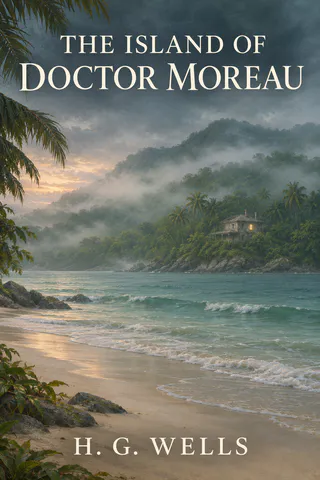
The Island of Doctor Moreau
H. G. Wells

The Island of Doctor Moreau
FictionClassicsScience FictionHorror
3.73from 140,420 ratingson Goodreads
"The Island of Doctor Moreau" by H. G. Wells is a science fiction novel published in 1896. Shipwrecked scientist Edward Prendick finds himself stranded on a remote island inhabited by Doctor Moreau, a disgraced physiologist conducting horrific experiments. Through vivisection, Moreau transforms animals into human-like creatures called the Beast Folk, who struggle to maintain their humanity under a strict code of laws. As Prendick uncovers the dark secrets of the island, he confronts questions about the boundaries of science, the nature of human identity, and the price of unchecked ambition.
Contains spoilers for the entire book
- Themes
- Atmosphere
About the book
Published by Heinemann in 1896, The Island of Doctor Moreau is the story of Edward Prendick, an English gentleman who once studied biology under Huxley, found adrift in the Pacific eleven months after the wreck of the Lady Vain; his account was found among his papers by his nephew and heir. Rescued from the wreck’s dinghy by a schooner carrying a cargo of animals, Prendick is put ashore on a remote island with Montgomery, a medical man in disgrace, and his strange, misshapen attendant. The island belongs to Doctor Moreau, an eminent physiologist driven out of England years before, when a journalist exposed his experiments. What Prendick finds there, the cries from the locked enclosure, the creatures in the forest chanting their Law, and Moreau’s calm account of what he is doing and why, appalled many of the book’s first reviewers. Written while the vivisection debate divided Britain and Darwin’s ideas were still new, it asks where the line between animal and human lies and what science may do in the name of knowledge, and it remains one of the founding works of science fiction.
Characters
Edward Prendick — Narrator
A shipwrecked English gentleman with a training in biology, who finds himself the unwilling guest of Moreau’s island and tells its story.
Doctor Moreau — Physiologist
An eminent scientist driven out of England when his experiments were exposed, who now works undisturbed on a Pacific island, indifferent to the pain he causes.
Montgomery — Moreau’s assistant
A flaxen-haired medical man who left London in disgrace, rescues Prendick from the sea, and drinks to forget where he has ended up.
M’ling — Montgomery’s attendant
Montgomery’s devoted servant, a bear tainted with dog and ox, whose pointed ears and shining eyes are the first thing about the island that frightens Prendick.
The Sayer of the Law — Keeper of the Law
A grey, hairy creature who sits in the darkness of a hut and leads the Beast Folk in chanting the Law.
The Ape-man — One of the Beast Folk
The first of the creatures to befriend Prendick, proud of his five fingers and fond of gabbling what he calls “Big Thinks”.
The Leopard-man — One of the Beast Folk
A creature who stalks Prendick on his first night and is the first to break the Law openly.
The Hyena-swine — One of the Beast Folk
The most dangerous of the Beast Folk, who comes to see Prendick as his enemy.
The Dog-man — One of the Beast Folk
A creature made from a Saint Bernard, who attaches himself to Prendick with a dog’s loyalty.
About the author
H. G. Wells (1866–1946) was an English writer who trained as a biology teacher under T. H. Huxley, and the scientific romances he wrote in the 1890s supplied science fiction with most of its furniture: the time machine, the alien invasion, the invisible man, the animal made human in a laboratory. He was also a prolific journalist, historian and socialist campaigner who wrote more than a hundred books and expected to be remembered for the arguments rather than the stories. His novels include The Time Machine, The Island of Doctor Moreau, The Invisible Man and The War of the Worlds.